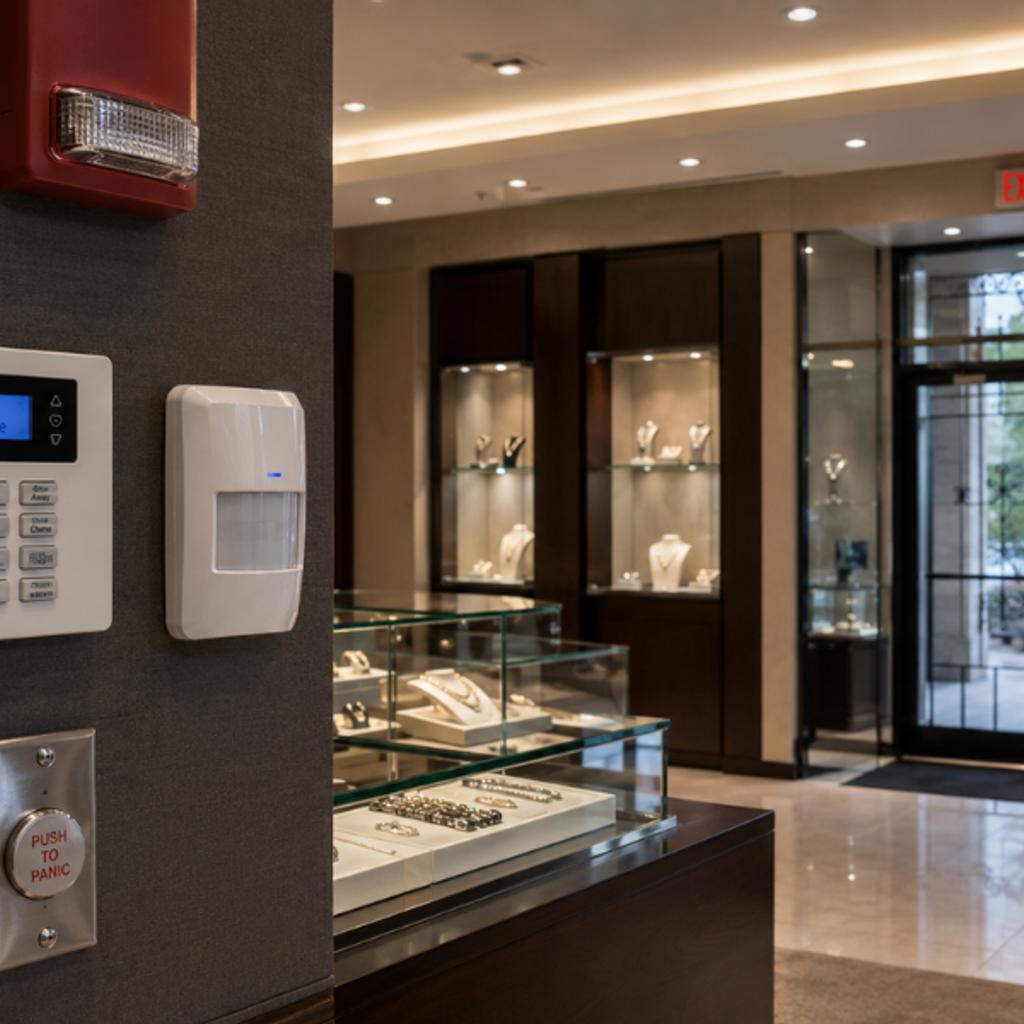
UL-Compliant Intrusion Alarm Systems for Banks & Jewelry Stores
When you operate a bank, jewelry store, high-value retailer, financial institution, or other high-risk commercial property, a basic burglar alarm may not provide the level of protection your business, insurance company, or security requirements demand.
These businesses can face sophisticated burglary, robbery, hold-up, after-hours intrusion, and communication-cutting attempts. For that reason, insurers, corporate security departments, lenders, or other stakeholders may require—or strongly prefer—an alarm system and monitoring service that meets applicable UL requirements.
But what does “UL alarm” actually mean?
It is more than simply buying a control panel with a UL mark.
What Is a UL-Compliant Intrusion Alarm System?
A properly certified commercial burglar alarm involves more than individual pieces of equipment.
UL Solutions identifies two important standards for burglar and hold-up alarm service:
- UL 681 – Installation and Classification of Burglar and Holdup Alarm Systems
- UL 827 – Central Station Alarm Services
UL 681 addresses how burglar and hold-up alarm systems are installed and classified. UL 827 addresses the operation and reliability of central stations providing alarm monitoring services.
This distinction is important.
A business can have UL Listed alarm equipment without necessarily having a UL Certified protected-property alarm system.
For a UL certificate, the installation, equipment, monitoring and associated alarm services must meet the applicable requirements, and the certificate must be issued through an appropriately UL Listed alarm service provider. UL states that protected-property certificates document features of the installed system and related services and are often requested by insurers and code officials.
Why Banks and Jewelry Stores Require a Higher Level of Security
Think about the difference between a normal office and a jewelry store.
An office burglar may be looking for computers or other equipment. A jewelry store can contain hundreds of thousands—or even millions—of dollars of merchandise concentrated in a relatively small area.
Banks and financial institutions face their own risks, including robbery, hold-up events and attacks against secured areas.
For these businesses, an intrusion alarm should be designed as a complete security system, not simply as a keypad connected to a few door contacts.
A professional design may include perimeter protection, interior detection, safe or vault protection, hold-up devices, supervised alarm communications, backup power and professional central-station monitoring.
The exact protection required depends on the property’s risk, system classification, insurer requirements and applicable UL certification requirements.
UL Listed Equipment vs. a UL Certified Alarm System
This is one of the most common areas of confusion.
UL Listed Equipment
Individual products can be tested and certified for specific applications. UL 2610, for example, covers commercial premises security alarm units and systems at the product level.
Products can include components such as:
- Intrusion alarm control equipment
- Keypads
- Door and window contacts
- Motion detectors
- Hold-up devices
- Power supplies
- Alarm communication equipment
- Sounding devices
UL Certified Alarm Service
Certification of the protected property goes further.
UL explains that its alarm service certification program evaluates an alarm company’s ability to install, maintain, test, inspect and monitor alarm systems, along with other required service elements.
In other words:
UL Listed equipment is a component of the system. A UL certificate addresses the protected-property alarm system and the associated service.
Simply installing UL Listed devices does not automatically make a business’s entire alarm system UL Certified.
What Does UL Look for?
A properly designed system starts with understanding the protected property.
For a jewelry store, this could include the showroom, exterior doors, glass storefront, office, inventory room and safe or vault areas.
For a bank, protection requirements can involve public areas, employee-only spaces, secured rooms, vault areas and hold-up alarm locations.
The alarm professional then determines the appropriate protection strategy.
1. Perimeter Protection
The goal is to detect unauthorized entry through vulnerable points.
Depending on the facility and applicable requirements, protection could involve doors, windows, walls, ceilings, roof areas or other potential entry points.
2. Interior Protection
Interior motion detection provides another layer of security if an intruder successfully gets through the perimeter.
Detector placement matters. Simply installing one motion detector in the center of a large building may leave important areas inadequately protected.
3. Safe and Vault Protection
For jewelry stores and financial facilities, the safe or vault may represent the most important target.
The security design may therefore require additional protection specifically around high-value storage areas.
UL also maintains separate standards covering physical security products such as burglary-resistant safes, vault doors and combination locks.
4. Hold-Up and Duress Protection
Banks and jewelry stores must consider more than burglary after closing.
A robbery can happen while employees and customers are inside.
Depending on the security plan and applicable requirements, strategically located hold-up or duress devices can allow employees to transmit an alarm without relying on the normal intrusion detection process.
Employee training is just as important as installing the device.
5. Supervised Alarm Communication
A security system is only useful if its alarm signal can reach the monitoring facility.
Commercial alarm designs should consider what happens if:
- Internet service fails
- Power is disconnected
- A communication path is damaged
- Equipment develops a fault
- The primary communication method becomes unavailable
Depending on the applicable system requirements, primary and secondary communication methods may be part of the design. UL’s central-station burglar alarm documentation specifically distinguishes between primary and secondary alarm transmission methods.
6. Backup Power
A burglar should not be able to defeat the entire security system simply by turning off electrical power.
Alarm control equipment and communications therefore need properly designed standby power consistent with the equipment, installation and applicable requirements.
Why the Monitoring Station Matters
Many business owners assume:
“My alarm is professionally monitored, so it must be UL.”
That isn’t necessarily true.
UL evaluates central stations under UL 827, Standard for Central Station Alarm Services. The evaluation addresses areas such as the facility, equipment, standby power, communications infrastructure, physical security, staffing, signal processing and record keeping.
UL also conducts ongoing audits of Listed monitoring companies to help verify continued compliance.
For a bank or jewelry store seeking a UL certificate, it is therefore important to establish the certification requirement before selecting the alarm configuration and monitoring arrangement.
The UL Certificate Is Important
A common mistake is asking:
“Is my alarm UL Listed?”
A better question is:
“Does my property require a UL certificate, and can my alarm service provider issue and maintain the required certificate?”
UL provides specific protected-property documentation, including forms for bank burglar alarm systems as well as central-station and mercantile burglar alarm systems.
UL states that when a protected property has a UL certificate, stakeholders can have increased confidence that the alarm was installed by an appropriately UL Listed alarm company, applicable equipment and installation requirements are being followed, and required monitoring, maintenance and service elements are being provided under the certification program.
Jewelry Store Owners: Talk to Your Insurance Company First
Before designing or replacing a jewelry-store alarm system, ask your insurance company or broker exactly what security requirements apply to your policy.
Don’t simply ask:
“Do I need an alarm?”
Ask:
“Do you require a UL certificate or a particular burglar alarm classification or level of protection?”
Also ask whether the insurer has requirements concerning safe/vault protection, hold-up protection, communications, opening/closing supervision, video surveillance, access control or monitoring.
Getting these answers before installation can prevent expensive changes later.
Banks and Financial Institutions Need the Same Planning
Banks, credit unions and other financial institutions should also establish their security and certification requirements before equipment is ordered.
UL maintains a specific Bank Burglar Alarm System certificate process and alarm-system description documentation.
The appropriate system should therefore be engineered around the institution’s actual risk and certification requirements—not around a generic commercial alarm package.
Common Mistakes to Avoid
One of the biggest mistakes is choosing equipment first and asking about UL requirements afterward.
Other common problems include installing UL Listed equipment and assuming the entire installation is certified, using a monitoring provider without confirming the required UL service category, failing to protect critical areas such as safes or vaults, relying on an inadequately designed communication path, and failing to maintain documentation or service after installation.
A high-security alarm system should be treated as an ongoing security service rather than a one-time equipment purchase.
Intrusion Alarm + Video + Access Control
For higher-risk businesses, intrusion detection becomes even more effective when it is part of a layered security strategy.
A modern jewelry store or financial facility can combine:
Intrusion Alarm → Access Control → Video Surveillance → Hold-Up Protection → Central Station Monitoring
Video can provide visual evidence and help investigate events. Access control can restrict employee-only and high-security areas. Intrusion detection protects the property during closed hours. Hold-up protection addresses robbery situations while the business is occupied.
Each technology performs a different job.
How VBTRONICS Can Help
VBTRONICS designs and installs commercial security solutions for businesses that require more than a basic alarm package.
Our approach starts with understanding the property, risk level, insurance requirements and required monitoring or certification before recommending equipment.
Solutions can include:
- Commercial intrusion alarm systems
- Door, window and perimeter protection
- Interior motion detection
- Safe and high-security-area protection
- Hold-up and panic alarm solutions
- Supervised alarm communications
- Backup communication options
- Central-station monitoring
- Video surveillance integration
- Access control
- Remote support, testing and maintenance
For banks, jewelry stores and other high-value commercial facilities, security should be designed around the risk—not around the cheapest alarm package.
Planning a New Alarm System?
If your bank, jewelry store or high-value commercial property is opening a new location, replacing an existing alarm or being asked by an insurance company to provide UL-compliant protection, determine the certification requirements before installation begins.
VBTRONICS can help evaluate the property and develop an intrusion alarm, video surveillance and access-control strategy around the applicable requirements.
VBTRONICS
Commercial Security • Intrusion Alarm • Video Surveillance • Access Control
www.vbtronics.com
Compliance note: UL requirements vary according to the system classification, protected property, service arrangement and certificate being requested. Insurance carriers, authorities having jurisdiction and other stakeholders may impose additional requirements. Final system design and certification requirements should always be verified for the specific property.
Recent Posts
-
 Security Fog Systems: A Powerful Defense Against Smash-and-Grab Theft
 -
 Building a Safer, More Connected Tomorrow: VBTRONICS Security & Communication Solutions
 -
 Construction Site Security with Remote Guarding & Solar Surveillance
 -
 Construction site Off Grid Solution
 -
 Operation CameraSwarm: Over 14,000 Compromised Cameras Highlight the Need for Hardened Commercial Security Infrastructure
